Trending...
- RAS AP Consulting Advances 1099 Education and Readiness Initiative Through IFOL Training and Finance Technology Showcase - 126
- International Misophonia Foundation Launches Sensory Accessible Technology Initiative to Address Overlooked Digital Accessibility Barriers - 103
- ALight Technology And Services Limited Advances Through Peachscore + Dealum Accelerator and Join LvlUp Labs
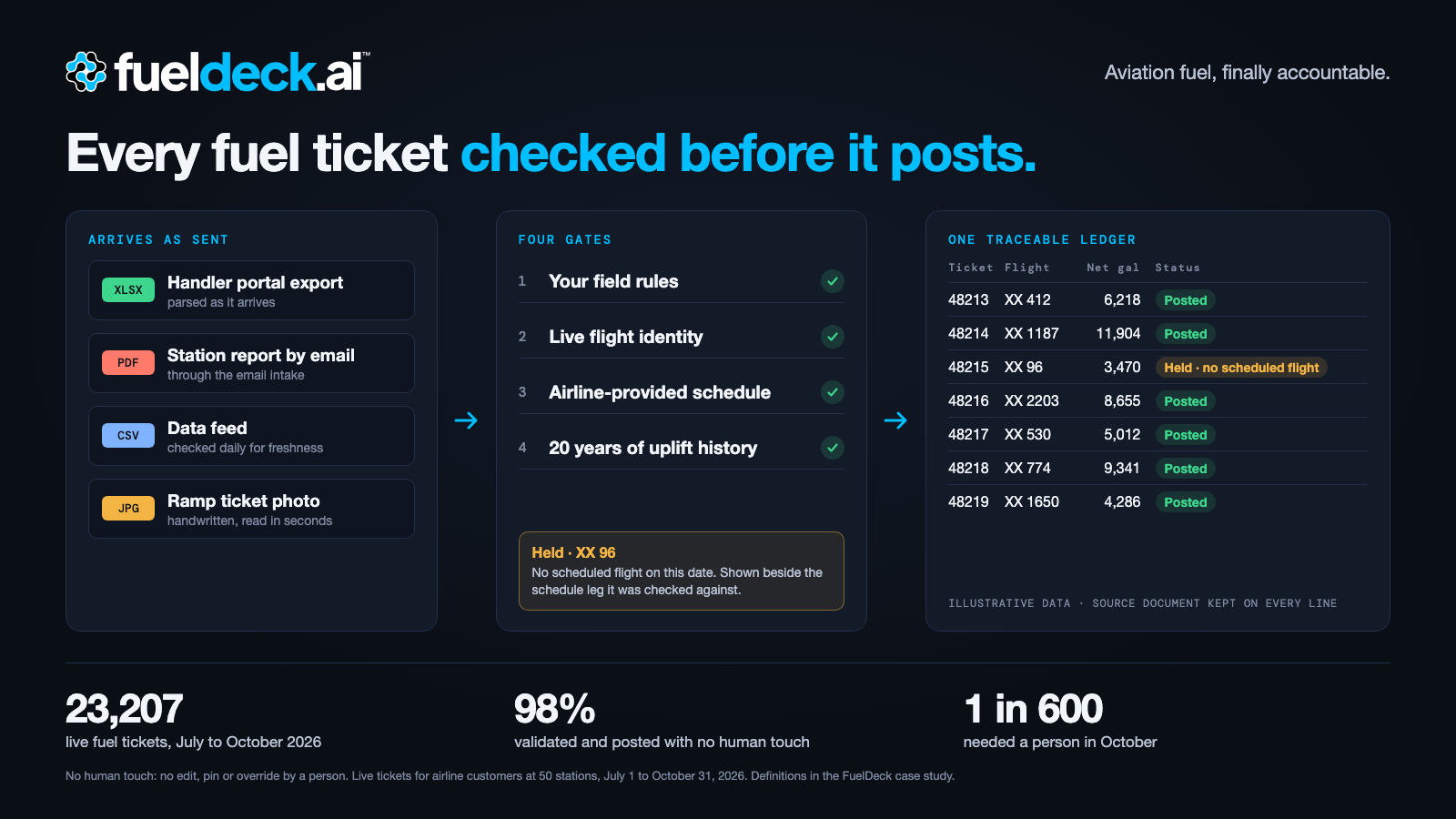

After 30 years of airline fuel accounting and more than 23,000 live tickets at 98% with no human touch, Logicraft ships AI that reads fuel records as they arrive, validates each against the scheduled flight and learns from every correction.
ENGLEWOOD CLIFFS, N.J. - Michimich -- Logicraft Corporation, the aviation fuel accounting firm founded by Avery J. Kraft in 1994, today announced the general availability of FuelDeck™ (https://fueldeck.ai), an AI-driven aviation fuel data platform that collects fuel records from handler portals, data feeds and email, reads them the way a fuel accountant would, checks every quantity and flight detail, and delivers traceable data to the teams and systems that reconcile and account for fuel. FuelDeck is built for fuel accounting teams at airlines, for into-plane fueling agents, and for airports and fuel consortia that still turn handler files, portal exports and ramp tickets into accounting by re-keying and spreadsheet reconciliation.
Every uplift of jet fuel produces a record, and it reaches the airline in whatever shape the handler's systems give it: an Excel or CSV export, a PDF report in an inbox, and for a significant share of uplifts a ticket written by hand at the wing. A 2026 Skymetrix study of 1.12 million airline fuel and airport-charge invoices across 31 airlines found that 40 percent still arrive as paper or unstructured PDF and are keyed by hand, and put the undetected errors airlines pay out at $4.6 billion a year.
Proven on live tickets before launch
Logicraft did not launch FuelDeck™ on a demonstration. From July 1 through October 31, 2026 it ran the platform on live fuel tickets for its airline customers, about 190 a day for 395 aircraft at 50 stations, most of them in North America and the Caribbean. Every ticket arrived as the Excel, PDF and CSV files handlers already produce; none was scanned at a desk. On September 23 full automation went live, with a stricter gate that matches every ticket to the airline's schedule. Every case an operator ruled on was built in as a standing rule, and by October tickets needing a person fell to 0.2 percent, one ticket in 600. Across 23,207 tickets, 98 percent were validated and posted with no human touch, and 348 tickets, 1.5 percent, needed a person's decision: a fuel day on an overnight flight, a tail number after an aircraft swap, a schedule mismatch to rule on. Those decisions took about six minutes of people's time a day. Every figure is read from the production database, not sampled, and the definitions behind each one are published in the case study, available from the contact below.
More on Michimich.com
"We spent three decades doing this work by hand for airlines, so we know exactly where the numbers go wrong and what an auditor asks for," said Avery J. Kraft, Founder and Chief Executive Officer of Logicraft Corporation. "The cost in fuel accounting does not sit in the ticket. It sits in the hand-off: the re-keying, the chargeback filed a month later, the second truck written off as a duplicate, the ticket a source quietly revises after it has posted. FuelDeck™ is that experience turned into software. Every rule in it was signed off by people who did this work by hand. When it holds a ticket, it says why. When it posts one, the evidence stays on the line, and every gallon traces back to its source document and to the flight it was pumped into."
"Reading the ticket was never the hard problem," said Ronny Kraft, Chief Technology Officer, who led the FuelDeck build from first prototype through launch. "The hard problem is proving it: that this uplift went onto this flight, on this tail, in this quantity, before a finance team pays for it. The AI in FuelDeck is trained on into-plane fuel tickets, and its work begins where extraction ends. It knows when it is unsure and sends the ticket to a person rather than guess, and every correction a reviewer makes teaches it, so a mistake fixed in October does not come back in November."
Reads the ticket as it actually arrives
At the core of FuelDeck is FuelScanner™, the capture engine that reads a fuel record in the form it arrives. In production today that is overwhelmingly the Excel, PDF and CSV files that into-plane agents' systems export; a file in a layout FuelDeck has not seen is held for review rather than parsed on a guess. When the record is the ticket itself, FuelScanner reads handwritten, printed, thermal and faxed tickets and ramp photographs, returning more than 32 structured fields in under three seconds, with 99.9 percent accuracy on the four fields that decide the invoice: fuel temperature, API gravity, density and net gallons. Any field it is unsure of goes to a one-click human review with the original in view.
Four gates before anything posts
FuelCounter™ runs every ticket through four validation gates before it can be posted: the customer's own field rules; a flight-identity check against live departure data; a mandatory match against the airline-provided schedule; and an anomaly screen against two decades of uplift history for that route and aircraft type. A ticket that fails a gate is held with the reason, beside the schedule leg it was checked against. Gross, net and metered quantities are compared only on the appropriate basis, and a re-sent report, a corrected ticket and a second truck on one flight are told apart.
More on Michimich.com
One ledger, and AI that keeps learning
A ticket that passes posts to a single ledger that feeds inventory reconciliation, receipts and transfers, station close, and dashboards by airline, airport and route. Every posted line keeps its source document, the review decisions and the delivery status. A ticket held because the flight written on it never operated is re-matched against the airline's schedule and heals onto the flight that actually fuelled, often within minutes. A person stands at every gate: nothing heals past a material difference in quantity, and nothing becomes a rule without sign-off. VersoData™ lets a fuel accountant ask the ledger a question in plain English and get a table or a chart back.
Records flow in automatically through a dedicated email intake, secure file transfer and direct connections to into-plane agent portals. Validated records leave in the A4A and IATA standard XML that fuel management and accounting systems expect, so finance teams keep their existing systems of record.
The full FuelDeck™ suite
FuelDeck™ already supports operations at more than 480 airports and over 726 million gallons of jet fuel a year.
Nothing to install
FuelDeck runs in the cloud, so there is nothing to install and no implementation programme to fund. Pricing is per ticket with volume tiers, so cost tracks the work actually done. It runs on Google Cloud with per-tenant isolation and data encrypted in transit and at rest.
Availability
FuelDeck™ is available today at https://fueldeck.ai. Airlines, into-plane agents and airports can request an exploratory call or a live demonstration on their own tickets by contacting rkraft@logicraft.com.
About Logicraft Corporation
Founded in 1994 by Avery J. Kraft, who leads the company today as Chief Executive Officer, and based in Englewood Cliffs, New Jersey, Logicraft Corporation provides aviation fuel accounting, reconciliation, and data services to airlines and fuel operators. FuelDeck™ is that three-decade practice turned into software. Learn more at https://fueldeck.ai and https://logicraft.com.
Every uplift of jet fuel produces a record, and it reaches the airline in whatever shape the handler's systems give it: an Excel or CSV export, a PDF report in an inbox, and for a significant share of uplifts a ticket written by hand at the wing. A 2026 Skymetrix study of 1.12 million airline fuel and airport-charge invoices across 31 airlines found that 40 percent still arrive as paper or unstructured PDF and are keyed by hand, and put the undetected errors airlines pay out at $4.6 billion a year.
Proven on live tickets before launch
Logicraft did not launch FuelDeck™ on a demonstration. From July 1 through October 31, 2026 it ran the platform on live fuel tickets for its airline customers, about 190 a day for 395 aircraft at 50 stations, most of them in North America and the Caribbean. Every ticket arrived as the Excel, PDF and CSV files handlers already produce; none was scanned at a desk. On September 23 full automation went live, with a stricter gate that matches every ticket to the airline's schedule. Every case an operator ruled on was built in as a standing rule, and by October tickets needing a person fell to 0.2 percent, one ticket in 600. Across 23,207 tickets, 98 percent were validated and posted with no human touch, and 348 tickets, 1.5 percent, needed a person's decision: a fuel day on an overnight flight, a tail number after an aircraft swap, a schedule mismatch to rule on. Those decisions took about six minutes of people's time a day. Every figure is read from the production database, not sampled, and the definitions behind each one are published in the case study, available from the contact below.
More on Michimich.com
- Xmas Delights Highlights Quality and Safety in Professional Christmas Light Installation
- OncoBeta Introduces Rhenium-SCT for Non-Melanoma Skin Cancer at Theageneio Cancer Hospital of Thessaloniki
- Carter's Brings New Concept Store to Rochester Hills, Michigan at The Village of Rochester Hills
- Brian G. Miller Co., LLC Receives Tier 1 Ranking in the 2027 Edition of Best Law Firms®
- The Villari Firm, PLLC Named to the 2027 Edition of Best Law Firms
"We spent three decades doing this work by hand for airlines, so we know exactly where the numbers go wrong and what an auditor asks for," said Avery J. Kraft, Founder and Chief Executive Officer of Logicraft Corporation. "The cost in fuel accounting does not sit in the ticket. It sits in the hand-off: the re-keying, the chargeback filed a month later, the second truck written off as a duplicate, the ticket a source quietly revises after it has posted. FuelDeck™ is that experience turned into software. Every rule in it was signed off by people who did this work by hand. When it holds a ticket, it says why. When it posts one, the evidence stays on the line, and every gallon traces back to its source document and to the flight it was pumped into."
"Reading the ticket was never the hard problem," said Ronny Kraft, Chief Technology Officer, who led the FuelDeck build from first prototype through launch. "The hard problem is proving it: that this uplift went onto this flight, on this tail, in this quantity, before a finance team pays for it. The AI in FuelDeck is trained on into-plane fuel tickets, and its work begins where extraction ends. It knows when it is unsure and sends the ticket to a person rather than guess, and every correction a reviewer makes teaches it, so a mistake fixed in October does not come back in November."
Reads the ticket as it actually arrives
At the core of FuelDeck is FuelScanner™, the capture engine that reads a fuel record in the form it arrives. In production today that is overwhelmingly the Excel, PDF and CSV files that into-plane agents' systems export; a file in a layout FuelDeck has not seen is held for review rather than parsed on a guess. When the record is the ticket itself, FuelScanner reads handwritten, printed, thermal and faxed tickets and ramp photographs, returning more than 32 structured fields in under three seconds, with 99.9 percent accuracy on the four fields that decide the invoice: fuel temperature, API gravity, density and net gallons. Any field it is unsure of goes to a one-click human review with the original in view.
Four gates before anything posts
FuelCounter™ runs every ticket through four validation gates before it can be posted: the customer's own field rules; a flight-identity check against live departure data; a mandatory match against the airline-provided schedule; and an anomaly screen against two decades of uplift history for that route and aircraft type. A ticket that fails a gate is held with the reason, beside the schedule leg it was checked against. Gross, net and metered quantities are compared only on the appropriate basis, and a re-sent report, a corrected ticket and a second truck on one flight are told apart.
More on Michimich.com
- Bacchus Wine & Spirits and Michelin Guide–Recommended Ethel's Fancy to Host Exclusive LOUIS XIII Limited Edition Diwali Decanter Celebration
- Arizona Pest Control Surpasses $200,000 in Contributions to Southern Arizona High School Sports and Education Programs
- ZenaTech (NAS DAQ: ZENA) $1 Million in New Utility Contracts- Potential $2.5 Million Follow-On Opportunity Puts Its Drone Business in the Spotlight!
- New Patient Data Show REQORSA® Activating Cellular Repair Pathways as Roche Collaboration Advances Precision Lung Cancer Strategy for Genprex, Inc
- Genuine Hospitality, LLC Selected to Operate Holiday Inn Express & Suites Jacksonville – Town Center
One ledger, and AI that keeps learning
A ticket that passes posts to a single ledger that feeds inventory reconciliation, receipts and transfers, station close, and dashboards by airline, airport and route. Every posted line keeps its source document, the review decisions and the delivery status. A ticket held because the flight written on it never operated is re-matched against the airline's schedule and heals onto the flight that actually fuelled, often within minutes. A person stands at every gate: nothing heals past a material difference in quantity, and nothing becomes a rule without sign-off. VersoData™ lets a fuel accountant ask the ledger a question in plain English and get a table or a chart back.
Records flow in automatically through a dedicated email intake, secure file transfer and direct connections to into-plane agent portals. Validated records leave in the A4A and IATA standard XML that fuel management and accounting systems expect, so finance teams keep their existing systems of record.
The full FuelDeck™ suite
- FuelScanner™ (available now): capture of fuel records from handler files to handwritten tickets and ramp photos.
- FuelCounter™ (available now): four-gate validation, posting, inventory reconciliation, receipts and transfers, station close, and dashboards.
- VersoData™ (available now): plain-English questions over the ledger, with tables and charts back.
- DutyCounter™ (coming H2 2026): duty and recovery reporting built from the same flight and fuel record.
- FuelTaxPRO™ (coming 1H 2027): aviation fuel tax reporting from the same ledger.
FuelDeck™ already supports operations at more than 480 airports and over 726 million gallons of jet fuel a year.
Nothing to install
FuelDeck runs in the cloud, so there is nothing to install and no implementation programme to fund. Pricing is per ticket with volume tiers, so cost tracks the work actually done. It runs on Google Cloud with per-tenant isolation and data encrypted in transit and at rest.
Availability
FuelDeck™ is available today at https://fueldeck.ai. Airlines, into-plane agents and airports can request an exploratory call or a live demonstration on their own tickets by contacting rkraft@logicraft.com.
About Logicraft Corporation
Founded in 1994 by Avery J. Kraft, who leads the company today as Chief Executive Officer, and based in Englewood Cliffs, New Jersey, Logicraft Corporation provides aviation fuel accounting, reconciliation, and data services to airlines and fuel operators. FuelDeck™ is that three-decade practice turned into software. Learn more at https://fueldeck.ai and https://logicraft.com.
Source: Logicraft, Corporation
0 Comments
Latest on Michimich.com
- Building a Technology Powerhouse-From AI Drones and Global Acquisitions to Defense, Enterprise Software and the Future of Autonomous Operations $ZENA
- Ann Arbor Area Community Foundation Announces New Roles for Nathan Smith and Cecelia Hopkins
- Shelter Structures America backs MATRA Second Life Project to turn retired tent vinyl into homes for displaced families
- P-Wave Press Announces Becoming Dad: Reflections for New Fathers by L. A. Davenport
- Inaugural OC Tech Week Draws 3,000 From 12 Countries, Sends Finalist to $1M Startup World Cup
- Award-Winning American Hotelier Opens Art-Filled Luxury Cottage in Norfolk, England
- K2 Global / Ozi Amanat Named Among Top 100 AI Venture Capitalists in 2026
- Dr. Latorial Faison Appointed Poet Laureate of Virginia
- AdLeverage Brings Golf Simulator Contest and Home Services Marketing Expertise to Service World Expo 2026
- Cleveland Factory Worker Seeks Funding for AI-Readable Archive Exploring Advanced AI Restraint and Human Survival
- Jewell Clip Launches Wig Collection, Expanding Its Mission to Empower Women Experiencing Hair Loss
- TradeJARnal Launches Innovative Trading Journal to Help Stock and Options Traders Build Discipline and Smarter Trading Habits
- Pursant Founder Mark Herbick Joins STS Capital Partners as CEO
- Hillside Terrace Invites Families to Experience Community Life on a Personal Tour
- Michigan License Lawyer Dan Geherin Warns of Holiday OWI and Interlock Violations
- AAACF Strengthens Community Investment Team with Leadership Roles for Amina Iqbal and Anahid Matossian
- Tampa Holiday Sessions: Captured by Mallary Opens 2026 Christmas Minis With Two New Sets
- Tampa Web Design Launches New Website for Entrepreneur and Capital Markets Advisor Martin Sumichrast
- ArborMotion Highlights the Importance of Specialized Audi Service in Ann Arbor