Trending...
- Building a Diversified Healthcare Platform as Exosome Science, Telehealth, Diagnostics & Strategic Acquisitions Converge: NexTel Medical (OTCID: MAJI) - 130
- Infinity Infusion Solutions Named Finalist for D Magazine's D CEO 2026 Excellence in Healthcare Awards - 126
- Allstream Energy Partners Nominated in Multiple Categories for Fast Company's Best Workplaces for Innovators - 117
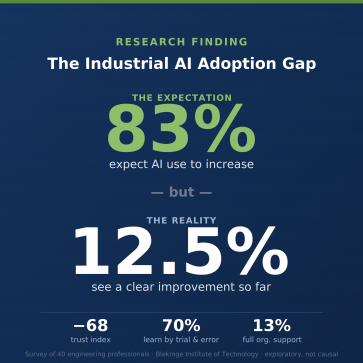
New research suggests that making AI available isn't enough: engineers adopt it only when they can understand, verify, and trust its outputs.
DETROIT - Michimich -- A newly completed master's thesis offers fresh evidence on why artificial intelligence (AI) initiatives in industrial organizations often fall short of expectations, concluding that the decisive factors are human and organizational rather than technical.
The research, completed as part of an MBA at Blekinge Institute of Technology (BTH) in Sweden by Abed Almalik Jberi and Abdul Salam Jeber, draws on a real-world AI change initiative within a global industrial manufacturing organization. The authors surveyed 40 engineering professionals — a predominantly senior sample, with 65% reporting more than ten years of professional experience and roughly 30% in leadership positions — using a quantitative descriptive survey design to analyze employees' perceptions of trust, organizational support, learning conditions, and acceptance.
The findings point to a pronounced gap between expectation and present experience. Although 88% of respondents anticipated increased AI use over the next three years, trust in AI recommendations was negative (Net Promoter Score of -68) and confidence in daily use was also negative (-47). Only 8% of respondents reported receiving formal training, with most acquiring AI skills through trial and error.
More on Michimich.com
To interpret these patterns, the study integrates two established frameworks — the Prosci ADKAR model of organizational change and Knapp's Relationship Model — positioning AI adoption as both a change process and a gradual process of trust-building. The analysis indicates that trust in AI was conditional, depending on the extent to which employees could understand, verify, and validate AI outputs against real-world results.
On the basis of these findings, the study identifies four conditions that support effective adoption: transparent communication, explainable AI systems, role-specific training, and sustained organizational support. Its central contribution is to demonstrate that the human dimension of AI adoption is not secondary to industrial performance, but a precondition through which AI becomes economically and organizationally valuable.
"AI tools are only as valuable as the trust people place in them. Our findings show that without transparency, training, and support, even capable AI systems remain underused," said Abed Almalik Jber, co-author of the study.
More on Michimich.com
The full research link: https://www.diva-portal.org/smash/record.jsf?dswid=-5431&pid=diva2%3A2080043&c=2&searchType=SIMPLE&language=en&query=abed+almalik+&af=%5B%5D&aq=%5B%5B%5D%5D&aq2=%5B%5B%5D%5D&aqe=%5B%5D&noOfRows=50&sortOrder=a...
About the Authors
Abed Almalik Jber works at the Schaeffler Group USA and Abdul Salam Jeber working at Toyota Material Handling EU
The research, completed as part of an MBA at Blekinge Institute of Technology (BTH) in Sweden by Abed Almalik Jberi and Abdul Salam Jeber, draws on a real-world AI change initiative within a global industrial manufacturing organization. The authors surveyed 40 engineering professionals — a predominantly senior sample, with 65% reporting more than ten years of professional experience and roughly 30% in leadership positions — using a quantitative descriptive survey design to analyze employees' perceptions of trust, organizational support, learning conditions, and acceptance.
The findings point to a pronounced gap between expectation and present experience. Although 88% of respondents anticipated increased AI use over the next three years, trust in AI recommendations was negative (Net Promoter Score of -68) and confidence in daily use was also negative (-47). Only 8% of respondents reported receiving formal training, with most acquiring AI skills through trial and error.
More on Michimich.com
- Future Intelligence Think Tank Surpasses 1,000 Members Exploring Human and Artificial Intelligence
- Gary Bernstein Expands Media Leadership Role With Senior Strategic Advisor Appointment To Blacksun Private Equity
- Headline: House of Nova Paints Every Face in Gold at New York Fashion Week
- Can Government Operate Better Through Innovation?
- Michael H. Kaplan Advocates for Seriously Injured Colorado Workers Who Need In-Home Care
To interpret these patterns, the study integrates two established frameworks — the Prosci ADKAR model of organizational change and Knapp's Relationship Model — positioning AI adoption as both a change process and a gradual process of trust-building. The analysis indicates that trust in AI was conditional, depending on the extent to which employees could understand, verify, and validate AI outputs against real-world results.
On the basis of these findings, the study identifies four conditions that support effective adoption: transparent communication, explainable AI systems, role-specific training, and sustained organizational support. Its central contribution is to demonstrate that the human dimension of AI adoption is not secondary to industrial performance, but a precondition through which AI becomes economically and organizationally valuable.
"AI tools are only as valuable as the trust people place in them. Our findings show that without transparency, training, and support, even capable AI systems remain underused," said Abed Almalik Jber, co-author of the study.
More on Michimich.com
- KayeDinero Is Building the "Full-Stack Artist": Code, Music, Markets and Drone Cinema
- Infinity Infusion Solutions Named Finalist for D Magazine's D CEO 2026 Excellence in Healthcare Awards
- Novi Bathroom Remodel Company Gives Glass Shower Maintenance Tips
- Floors By Michael Announces Launch of New Website
- Canadian Tint Expo 2027: Why Every Window Tinter Should Compete in Niagara Falls on April 3rd & 4th
The full research link: https://www.diva-portal.org/smash/record.jsf?dswid=-5431&pid=diva2%3A2080043&c=2&searchType=SIMPLE&language=en&query=abed+almalik+&af=%5B%5D&aq=%5B%5B%5D%5D&aq2=%5B%5B%5D%5D&aqe=%5B%5D&noOfRows=50&sortOrder=a...
About the Authors
Abed Almalik Jber works at the Schaeffler Group USA and Abdul Salam Jeber working at Toyota Material Handling EU
Media Contact
Abed Almalik Jber & Abdul Salam Jeber
MBA graduate, Blekinge Institute of Technology
abjb23@student.bth.se
5863826320
Abed Almalik Jber & Abdul Salam Jeber
MBA graduate, Blekinge Institute of Technology
abjb23@student.bth.se
5863826320
Source: Malik Jber & Salam Jeber
0 Comments
Latest on Michimich.com
- Notaron Expands Online Notarization Access Following Wisconsin Approval
- Before Drake Was Drake, Detroit-Raised KayeDinero Was Already Watching Aubrey Graham
- Wings Air Helicopters Selected to Support VIP Transportation for Resorts World in New York
- Scoop Social Co. Brings Its Signature Mobile Dessert Experience to Houston This October
- Cass Tech Isn't Just a Song: KayeDinero's Detroit Story Started With Band, Soccer + Scholarship
- The Social Capital Revolution Comes to Phoenix!
- Lawsuit Alleges American Deli Food Caused Severe Illness, Acute Kidney Failure, And Eight-day Hospitalization
- FBI/DoW plot uncovered to hurt Trump/Vance through encouraged "widespread" cybersecurity breaches and racketeering theft of $80m in USDA payments
- Bettingbladet releases H1 2026 report on the Swedish online gambling market
- Garage door installation or repair in Minnesota? Which makes more sense for your family?
- Super Rooter Expands to 190 Plumbing, Sewer, and Drain Service Locations Across the United States
- European Patent for ALS Program Expands the Story: HOPE Deploys Robotic TMS & FDA Commercialization Path Advances: NRx Pharmaceuticals: NAS DAQ: NRXP
- VICTURY Sports Announces Formation of Youth Sports League Built on the Official, Patented, and Award-Winning Keepy Uppy® Ball
- ACTIQO Launches on iOS to Help Families Manage Everything Around Kids' Activities
- Hillside Terrace Senior Living Offers Free Assisted Living Guide for Families Exploring Senior Care
- How a Lost Driver's License in Michigan After an OWI Can Impact Your Career
- ArborMotion Offers Complimentary Back-to-School Vehicle Inspections
- DC Norris North America to Help Manufacturers Supercharge Kettles at PACK EXPO International 2026
- The Podcast of Power Returns With Exclusive Bear McCreary Interview
- Congressman Chuck Edwards (NC-11) Presents ReadyCommunities Partnership 2026 National Service Award to Local Businessman / US Air Force Veteran