Trending...
- DARPA Selects NRx Pharmaceuticals Defense Subsidiary for Contract Negotiations on FDA-Authorized SPARC-TMS Clinical Trial Advancing Mental Health Care - 176
- From the Racetrack to the Boardroom: Aston Martin and Aramco Formula One Partnership Accelerates Circle8 Group: (N A S D A Q: CIRC) - 154
- Cover Story about Matthew Cossolotto – Author of Harness Your PromisePower -- Published in July 2026 Enterprise World Magazine - 115
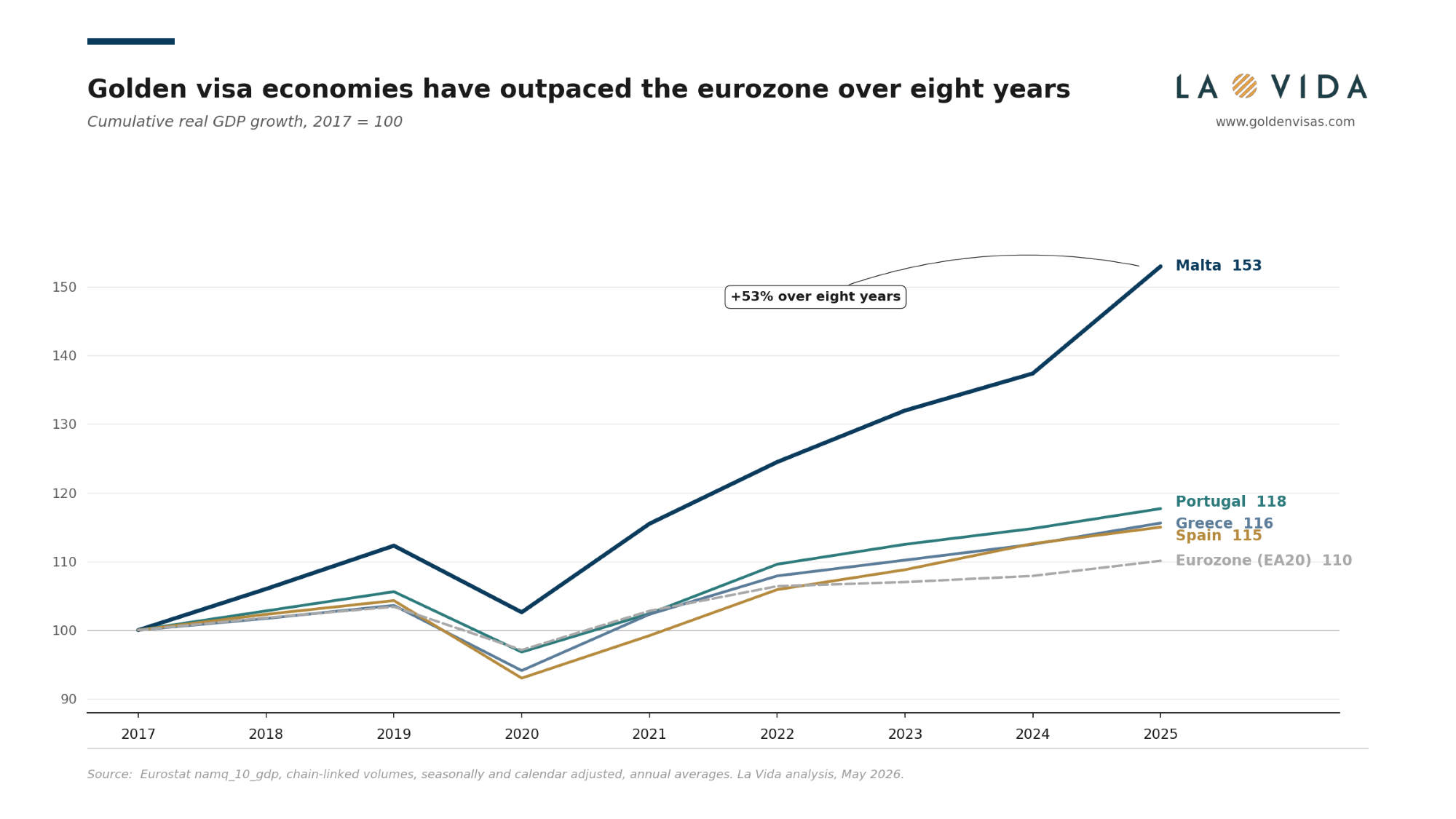

Real GDP in Malta, Portugal, Greece and Spain grew faster than the eurozone average from 2017 to 2025, according to research published today by investment migration firm La Vida. The four economies — all of which operated investment migration programmes throughout the period — outperformed the bloc on both aggregate and per-capita measures.
UXBRIDGE, U.K. - Michimich -- LONDON — The four European countries that ran continuous investment migration programmes from 2017 to 2025 each grew faster in real GDP terms than the eurozone average, new analysis from UK-based investment migration advisory firm La Vida has found.
Drawing on official Eurostat national accounts data, the research shows Malta's economy grew 53% in real terms over the eight years, Portugal by 17.7%, Greece by 15.6% and Spain by 15.0%. The eurozone aggregate over the same period grew 10.1%.
The pattern holds when adjusted for population. On a real GDP-per-capita basis, Malta grew by 22.4%, Greece by 19.3%, Portugal by 12.9% and Spain by 8.8%, against a eurozone figure of 7.7%.
More on Michimich.com
Direct investment associated with the programmes themselves is too small to account for the difference. La Vida estimates the qualifying investment generated by the four programmes sits in the range of 0.025% to 0.25% of national GDP per year — an order of magnitude or more below the size of the growth gaps observed.
Paul Williams, CEO and Founder of La Vida, said:
"European economies are struggling for growth while government debt continues to climb. Governments and the EU need to take a closer look at the role residency and citizenship by investment can play in attracting productive wealth into their economies. Our analysis doesn't prove the programmes drove the growth gap. But the direction of the data is hard to ignore, and the contribution of wealthy migrants extends well beyond their initial qualifying investment — through businesses they start, taxes they pay over time, and capital they go on to deploy."
La Vida research identifies three non-exclusive readings of the data. Direct investment under the programmes contributed to growth through real estate, construction, government revenue and associated multiplier effects, but at a modest scale. A second channel runs through the entrepreneurial behaviour of programme beneficiaries themselves — investment beyond the qualifying minimum, business formation, employment creation and tax contributions over time. A third reflects shared characteristics across the four economies that drove growth independently of investment migration policy, including post-pandemic tourism recoveries, EU recovery fund allocations, services exports and recovery from the post-2012 sovereign debt crisis.
More on Michimich.com
The European investment migration landscape has shifted markedly since the period analysed. Spain closed its programme in April 2025. Portugal removed real estate as a qualifying route in October 2023 shifting to Private Equity investment. Malta's citizenship-by-investment route was struck down by the European Court of Justice in April 2025, though its residence programme continues. Greece's programme remains open.
"The next eight years will not look like the last," Williams added. "Several of these programmes have been reformed or closed. But the debate about whether the underlying policy works — attracting wealth in exchange for residency or citizenship — is more relevant than ever. The UK has signalled interest in reintroducing an investor route. The US has its Trump Card proposal. Argentina has tendered for a new programme. Governments are looking at this again because debt levels and demographic pressures demand it."
The full analysis of GDP growth in golden visa countries, including methodology and source data, is available at www.goldenvisas.com/gdp-growth-in-eu-and-golden-visa-economies.
Drawing on official Eurostat national accounts data, the research shows Malta's economy grew 53% in real terms over the eight years, Portugal by 17.7%, Greece by 15.6% and Spain by 15.0%. The eurozone aggregate over the same period grew 10.1%.
The pattern holds when adjusted for population. On a real GDP-per-capita basis, Malta grew by 22.4%, Greece by 19.3%, Portugal by 12.9% and Spain by 8.8%, against a eurozone figure of 7.7%.
More on Michimich.com
- Roofman USA Serving More of Michigan than Ever!
- CRG Awarded NASA SEWP VI Contracts in Categories B and C
- Heidi G. Villari of The Villari Firm, PLLC Named to Super Lawyers for the Tenth Consecutive Year
- Elevate Your Sneakers With Crep Protect Trek Laces
- Meet Privateer: Tucson's High-Tech Security Force Built With Paramilitary Precision
Direct investment associated with the programmes themselves is too small to account for the difference. La Vida estimates the qualifying investment generated by the four programmes sits in the range of 0.025% to 0.25% of national GDP per year — an order of magnitude or more below the size of the growth gaps observed.
Paul Williams, CEO and Founder of La Vida, said:
"European economies are struggling for growth while government debt continues to climb. Governments and the EU need to take a closer look at the role residency and citizenship by investment can play in attracting productive wealth into their economies. Our analysis doesn't prove the programmes drove the growth gap. But the direction of the data is hard to ignore, and the contribution of wealthy migrants extends well beyond their initial qualifying investment — through businesses they start, taxes they pay over time, and capital they go on to deploy."
La Vida research identifies three non-exclusive readings of the data. Direct investment under the programmes contributed to growth through real estate, construction, government revenue and associated multiplier effects, but at a modest scale. A second channel runs through the entrepreneurial behaviour of programme beneficiaries themselves — investment beyond the qualifying minimum, business formation, employment creation and tax contributions over time. A third reflects shared characteristics across the four economies that drove growth independently of investment migration policy, including post-pandemic tourism recoveries, EU recovery fund allocations, services exports and recovery from the post-2012 sovereign debt crisis.
More on Michimich.com
- Dynamic Dachshund Dog Goes Global: Remember Point Launches a New Bilingual Children's Book
- DARPA Selects NRx Pharmaceuticals Defense Subsidiary for Contract Negotiations on FDA-Authorized SPARC-TMS Clinical Trial Advancing Mental Health Care
- Tano Jones Revelry Brings Storyteller Soul Music And Community Impact To Every Stop On Their Tour
- From the Racetrack to the Boardroom: Aston Martin and Aramco Formula One Partnership Accelerates Circle8 Group: (N A S D A Q: CIRC)
- Crystals, Fossils and Family Fun Headline 80th Greater Detroit Gem, Mineral & Fossil Show
The European investment migration landscape has shifted markedly since the period analysed. Spain closed its programme in April 2025. Portugal removed real estate as a qualifying route in October 2023 shifting to Private Equity investment. Malta's citizenship-by-investment route was struck down by the European Court of Justice in April 2025, though its residence programme continues. Greece's programme remains open.
"The next eight years will not look like the last," Williams added. "Several of these programmes have been reformed or closed. But the debate about whether the underlying policy works — attracting wealth in exchange for residency or citizenship — is more relevant than ever. The UK has signalled interest in reintroducing an investor route. The US has its Trump Card proposal. Argentina has tendered for a new programme. Governments are looking at this again because debt levels and demographic pressures demand it."
The full analysis of GDP growth in golden visa countries, including methodology and source data, is available at www.goldenvisas.com/gdp-growth-in-eu-and-golden-visa-economies.
Source: La Vida Europe Ltd
Filed Under: Business
0 Comments
Latest on Michimich.com
- Telecom Equipment Group Launches AI-Ready Modular Infrastructure Solution for Next-Gen Networks
- Allstream Energy Partners Returns as a Media Partner for the 2026 API Inspection & Mechanical Integrity Summit in San Antonio
- The GTI Institute of GMNF Rebrands as Institute for Confessionally Reformed Faith and Practice
- Anton R. Williams Launches New Center to Bridge Traditions Through Reformed Confessions
- PokerStars & Ladbrokes veteran buys into Finnish news media Rahapelisanomat
- Former Judge Chris Oldner Honored as Best Lawyer by "D Magazine" for 6th Straight Year
- Roofman USA Highlights Key Factors Homeowners Should Consider When Choosing a Roofing Contractor
- JMAC Highlights the Core Principles of Iaido and the Benefits of Traditional Japanese Sword Training
- CMR Mechanical Encourages Homeowners to Prep for Summer Power Outages With Reliable Generators
- Compressed Gas Technologies Highlights the Importance of Nitrogen in Additive Manufacturing
- Missouri Hemp Businesses File Federal Lawsuit Challenging HB 2641
- AdviCoach of Southeast Michigan Rebrands to AdviCoach Business Coaching
- Boston Industrial Solutions Launches New Citrine® SA1-370 Silicone Glue for Permanent Adhesion
- Northeast Airlines Launches New Asset Management Group
- The best view of your business isn't from your desk
- AI Visibility Labs LLC - Dallas Texas - July 16 2026
- NextBoat's AI-Powered Marine Marketplace Gains Momentum as Record Growth Signals an Inflection Point for Investors (N Y S E American: NXB)
- Stepping Off the Grid: Savista Retreat Announces New Experiential Packages in Jaipur for Travellers
- Where Is Your Faith The Movie and Sountrack
- Bynn Intelligence Ranks #1 in NIST Child Online Safety Evaluation for Ages 13–16